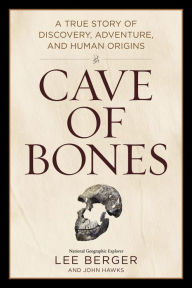
Cave of Bones by Lee Berger and John Hawks
Real life adventure and popular science combine in this thrilling, controversial book. First, in 2008, paleoanthropologist Lee Berger was out hiking with his dog and his son Matthew, 9. He was looking for potential sites to excavate, when Matthew found a fossil, which turned out to be a new species of hominin, Australopithecus Sediba, dated to about 1.9 million years old.
Then, in 2013, three cavers exploring for Lee Berger found a very deep and all but inaccessible cave, later called the Dinaledi Chamber, where they took photos of what appeared to be hominin bones. Berger quickly organized a three-week excavation, advertising for slender paleoanthropologists who weren’t claustrophobic. I have been on guided walks in several caves, but I’ve never gone spelunking or caving, where you need a headlamp and the ability to crawl, climb and rappel through very tight passages. The Dinaledi Chamber was extremely hard to access, with a tight squeeze through one tunnel, a climb into another, and finally a twelve-meter chute to climb down, through which most climbers would get stuck. Then they went through another chamber and finally into the magnificent Dinaledi Chamber, with beautiful flowstone above, and fossils almost everywhere below. The fossilized bones of at least 15 individuals were found, and over 1000 bones.
As the fossilized bones were revealed, carried out to the surface and analyzed, they found they had discovered a new species, named Homo Naledi, later estimated to be 250,000 to 350,000 years old. The brain was very small, and the shoulders and upper arms were like a climber, but the wrists, fingertips, and feet were much less primitive, not unlike our own. Also, their teeth and the hardened calculus around them indicate that they ate some plants. They were probably about 5 feet tall, with long arms, and walked upright. The exciting part is that Berger and his team, including co-author John Hawks, found some evidence of fire, graves, art and possibly tools.
I watched a Nova documentary from 2015, Dawn of Humanity, about the work done up to that time, and read a couple of recent articles about their findings. While National Geographic is firmly backing Berger and his team’s work, other scientists don’t agree with all these findings, particularly that of fire, art, and tool use. It will be interesting to see what else is found in the Rising Star Cave system. One very exciting section details Berger’s quest to enter the cave himself. In his late fifties, he is tall and not slender, but loses about 50 pounds to make the attempt, during which he spots some markings outside the chamber. Does he get down the chute? I’m not saying, but on his way back out of the cave system, he almost gets stuck and was reportedly injured. Also, he deliberately didn’t tell his family about his attempt to enter the Dinaledi Cavern ahead of time. As teens, Matthew Berger and his sister Megan both successfully made the journey.
The finds in the Dinaledi Cavern, however controversial, are remarkable and make for a compelling and fascinating read. For those with Netflix, there’s a new documentary, Unknown: Cave of Bones. For more about paleoanthropology, I enjoyed First Steps: How Upright Walking Made Us Human by Jeremy DeSilva. For real life adventure and caving, there’s Into the Planet: My Life as a Cave Diver by Jill Heinerth.
Brenda
 Book Girl & Little Bear