The Editor

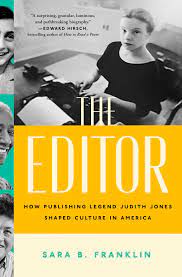
The Editor: How Publishing Legend Judith Jones Shaped Culture in America by Sara B. Franklin

Editor Judith Jones lived to be 93 and didn’t retire from Knop until she was 85. She edited many, many books and enjoyed many lunches with her authors. A couple of years in Paris as a young adult just after World War II inspired a love of food, cooking, and travel. Judith joined Knopf when it was rare for a woman to work in publishing as anything other than a secretary. When she became an editor, she worked very long hours, and became known as a passionate editor with a firm but delicate touch. She specialized in editing literary fiction, poetry, and food writing.

She married Dick Jones and they lived in New York City and Vermont. Dogs, swimming, music, poetry, and books filled their days. Infertility was a lifelong grief, though two stepchildren and later two older foster children expanded their family. Julia Child, Claudia Roden, Edna Lewis, and James Beard were some of the authors she worked with on bestselling cookbooks. The changing tastes in America for food and cookbooks is a major theme in this book. Also, quite a lot about being an underpaid woman in publishing, as well as growing old gracefully. Quite an interesting read, especially for foodies or avid cooks.

Brenda
Astronauts in Orbit: Two Books

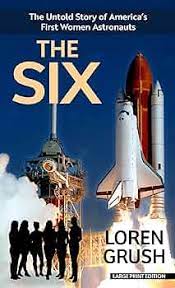
The Six: The Untold Story of America’s First Women Astronauts by Loren Grush

The NASA astronaut candidates of 1978 included six women who would all fly in near-earth orbit on the four space shuttles, before the construction of the International Space Station. The lengthy application and testing process is described in detail, along with the long wait to be selected for a space shuttle crew. Sally Ride became famous as the first American woman to orbit the earth, while Judith Resnick was better known for her second, ill-fated flight, on board Challenger in January, 1986. Sally was named to the the committee which investigated the Challenger disaster. Some information about the six was new to me, especially the stories of two women physicians, Anna Fisher and Rhea Seddon, who became pregnant and gave birth while waiting their turn to fly in space, and worked very close to their due dates and returned to work soon after. The six women, faced extra challenges due to their gender in a very male-dominated field, and added pressure from the media. This was great to read alternately with Orbital. Readalikes include The Mercury Thirteen by Martha Ackmann, Handprints on Hubble by Kathy Sullivan, and the novel The Calculating Stars by Mary Robinette Kowal.

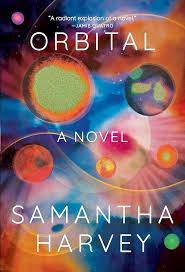
Orbital by Samantha Harvey

This beautiful, lyrical novel set a few years from now is a very memorable read, and will likely be nominated for multiple awards. It’s also short, and covers a single twenty-four hour day on the International Space Station. Four astronauts and two cosmonauts, from five countries, are several months into their overlapping nine-month stays on the station. The sixteen daily orbits around the planet reveal the beauty of the planet, the skies, and one massive typhoon heading for the Philippines, where Pietro and his wife met a fisherman and his family on their honeymoon. Chie learns that her mother has died in Japan. Their tedious daily exercise and tightly scripted work days contrast with the absolutely amazing sights including multiple sunrises, shared dreams, and relationships among the crew, their found family. The day described is also notable for another launch into space. Good Morning, Midnight by Lily Brooks-Dalton is a readalike for this excellent novel.

Brenda

The First Lady of World War II

The First Lady of World War II: Eleanor Roosevelt’s Daring Journey to the Frontlines and Back by Shannon McKenna Schmidt

 In August and September of 2023, first lady Eleanor Roosevelt spent five weeks in New Zealand, Australia, and the South Pacific, at the request of the President. Eleanor was also appointed a special Red Cross delegate and asked to inspect American Red Cross facilities. Well known for her newspaper columns “My Day,” the first lady was 58 and her four sons were all in the armed forces. Much of her visit was kept secret, with most of her columns published after her return and labeled, somewhere in Australia or somewhere in the South Pacific. I was surprised to learn that she traveled without an aide or companion, or even a single dress. She wore only Red Cross uniforms in seersucker or wool, and packed her manual typewriter, wiring her columns to her editor in New York.

While touring hospitals, Red Cross stations, cities, villages, military bases, and camps, she tried to spend as much time as possible with women doing war work, hospital patients, and enlisted men. The author spent four years researching and writing this book, which was a compelling and educational read for me. Eleanor visited Christmas Island, New Caledonia, Guadalcanal, and Oahu, among other islands. She wasn’t allowed to visit New Guinea and had to ask repeatedly to visit Guadalcanal. While there was some controversy over her trip, her visits with the troops were reportedly much enjoyed, and she tried to send a note to the family of every hospital patient she visited. The trip was very hard on her; she lost quite a bit of weight and was exhausted and depressed for a while upon her return, as the hospital visits took a toll and the sights she saw on the islands, including makeshift cemeteries, made her sad. Her observations for the President led to some improvements in conditions for the troops; her columns about her 25,000 mile journey helped educate Americans about life for Americans in the south Pacific, and she most definitely boosted morale for many. This fairly short, well researched and inspiring read certainly enlightened me about events and conditions in New Zealand, Australia, and the South Pacific in 1943. You can read Eleanor Roosevelt’s “My Day” columns here.

Brenda