
The Harvey Girls

The Harvey Girls by Juliette Fay

I enjoyed this absorbing historical novel set in 1926. Two young women, each with a big secret, train together in Topeka, Kansas, to become Harvey Girls. Billie, the oldest girl in a large hardworking family, is still 15, not 18 as required. She is homesick and a little clumsy, but very kind and charming to the customers at the Harvey House restaurant at the Topeka train station.

Charlotte, six years older, attended Wellesley College before dropping out to marry Simeon. Simeon is a brute, and hits Charlotte. She runs away to be a Harvey Girl, always worried he’ll find her. After training, Billie and Charlotte travel to the Grand Canyon, and are assigned to work as waitresses at the fancy El Tovar Hotel.

Charlotte doesn’t like to get close to the rim of the Grand Canyon while Billie befriends a park ranger and is eager to hike down into the canyon. Both of their secrets eventually cause problems, especially when they both meet men they really like. Charlotte becomes a part-time tour guide and makes a Hopi friend. Billie sends money home and worries about her family. The author has experience working as a waitress, which adds authenticity to Billie’s and Charlotte’s experience as Harvey Girls. A bit dramatic in spots, this is a very appealing read, with an excellent sense of time and place. An epilog fills the reader in on what happened after they left the Grand Canyon. I might need to watch Judy Garland sing “On the Atchison, Topeka and the Santa Fe” again in the 1946 movie “The Harvey Girls”.

Brenda
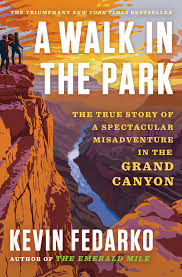
A Walk in the Park

A Walk in the Park: The True Story of a Spectacular Misadventure in the Grand Canyon by Kevin Fedarko

Fedarko, inspired by a book his dad gave him, thought he’d explore the Grand Canyon by river. Interning with a river tour company, he only became skilled enough to row a supply raft which hauled trash. He learned to love writing about the canyon and other wilderness areas, traveling with National Geographic photographer Pete McBride.

At McBride’s suggestion, they embarked on an end-to-end traverse inside the Grand Canyon from east to west, in several different expeditions. For their first section, an experienced group of canyon explorers welcomes them for 12 days—they don’t even last a full week. Their backpacks are way too heavy and disorganized and they didn’t prepare for all the off-trail walking, hiking, climbing, or rappelling among the many layers of rock. Daily, there is the challenge of reaching a safe camping spot before dark, in case of flash floods, and always being on the lookout for the next source of water, however tiny. Then there’s the need to consume massive amounts of calories and taking care of their feet.

Through the generosity of more experienced hikers, Kevin and Pete prepared for their next venture into the canyon, with the support of still others caching their resupply buckets and driving them to and from the canyon’s rim. Gradually they make their way west, with breaks to plan the next hike or for Kevin to visit his ailing father. This story is told with much more depth than many other real-life adventures, including lots of the history and prehistory of the canyon and the people who lived there and the artifacts they left. They met with members of the Navajo and Havasupai tribes, and Fedarko relates both sides of the recent influx of thousands of tourists from Las Vegas visiting the western Grand Canyon by helicopter.

The stunning beauty of the inner canyon is well described, making readers understand the appeal of this often extremely hot and always challenging journey, which made a huge impact on the author. Peter McBride has published a book of Grand Canyon photographs and there is a National Geographic documentary about their journey, Into the Grand Canyon, neither of which I’ve seen, yet. Many photographs by McBride are included in A Walk in the Park. This is a memorable and enjoyable read for those who enjoy armchair travel or real-life adventure tales.

Brenda