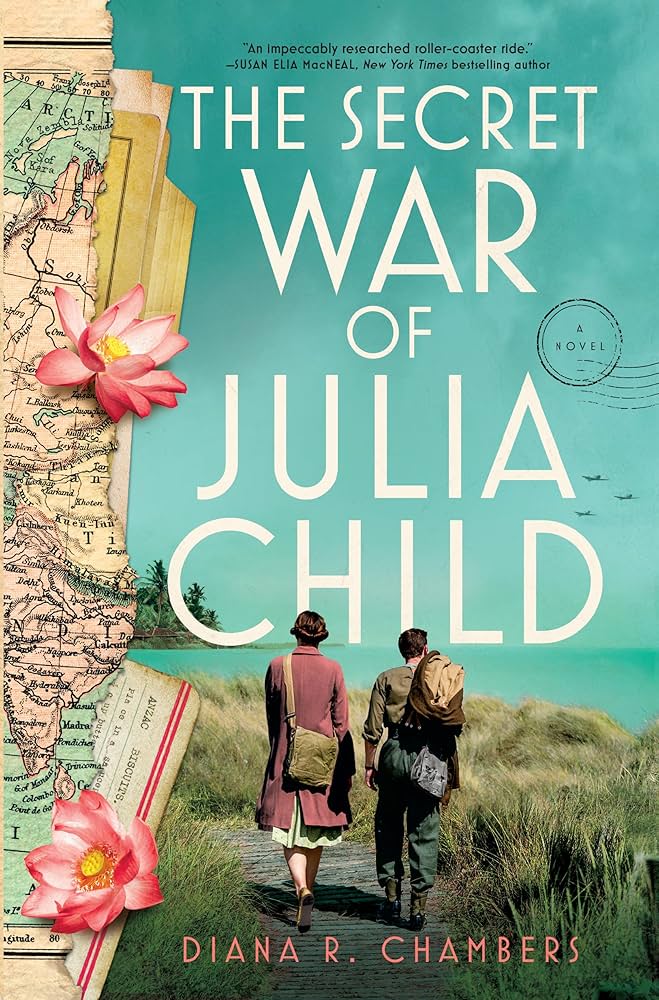
Diana Chambers takes the known facts of the life and work of Julia McWilliams (later Julia Child) from 1943 to 1945 and adds plenty of adventure, undercover work, and near-death experiences to create an exciting World War II novel set in Asia. Julia did work for the OSS, Office of Strategic Services, during the war in Ceylon (now Sri Lanka) and China, but didn’t talk much about her work. She certainly handled highly classified documents. Julia did meet and fall in love with mapmaker Paul Child, and they both enjoyed their introduction to Chinese food. The author traveled Julia’s route from India to Sri Lanka, then over the Himalayans to Kunming in western China, and her research brings the settings to life, along with the other historical characters. Readalikes include My Life in France by Julia Child with Alex Prud’homme and A Town Like Alice by Nevil Shute.
This engaging novel is set in Paris in 1956, featuring three women who met at Le Cordon Bleu several years ago. They have lost touch but reconnect in Paris. Parisian Claire is cooking at her father’s brasserie, but has dreams of cooking haute cuisine; especially challenging for a woman at that time. American Gina has broken off her engagement to Hal, an aspiring politician, after her father lost his fortune. She is writing a novel and works part-time at a bookstore.
Margot has returned from Australia, but is now going by Marie. She is working as a shop assistant at The House of Dior, and hasn’t let Claire know she’s back in Paris. Claire is gifted a gorgeous Dior gown, but has no occasion to wear it, so gives Gina the first chance to be fitted for the gown. Gina is invited to a ball where she’ll encounter her former fiancé Hal, who she still loves.
Cooking, fashion, and writing fill their days as the three women slowly reveal their secrets and alternately argue with and then support each other. Life for career women in 1950s Paris is challenging, and they all have decisions to make, as well as the chance for romance. Mid-century Paris is brought to life, making for an absorbing read that is neither lighthearted or too dark. Readalikes include Jacqueline in Paris by Ann Mah and Jennifer Robson’s The Gown and Coronation Year.
The Love Elixir of Augusta Stern by Lynda Cohen Loigman
After her mother’s death, Augusta Stern’s Great Aunt Esther moves into the family apartment above their drugstore. Solomon Stern is the pharmacist, older sister Bess sells cosmetics, Irving Rivkin is the delivery boy, and Augusta is a cashier who learns about medicine and healing from her father and her aunt. Esther treats patients in the apartment with soup and herbs. The book title is a bit misleading, as neither Esther or Augusta makes a love elixir, although there is a bit of magical realism to Esther’s methods.
Set in Brooklyn in the early 1920s, and in south Florida in 1987, this is a heartfelt and enjoyable historical novel. It’s unusual in that the same main character is featured in both timelines. At almost 80, Augusta is still working as a hospital pharmacist, having altered her birthdate. She is finally ready to retire and her niece Jackie finds her an apartment at Rallentando Springs, a development for seniors, most of them Jewish, that includes a swimming pool and a book club. Augusta swims in the pool daily, and is stunned to meet Irving, who was her teenage sweetheart. She also encounters her late friend Evie’s handsome husband Nathaniel, who is not friendly with Irving. I appreciated that the seniors here are depicted as vibrant, active, and fairly healthy.
The author was inspired by the story of her husband’s great grandmother Goldie, a pharmacist, and by her father’s move to an assisted living residence in south Florida. Daily life in Prohibition era Brooklyn really comes to life and it was fun to read about the fashion trends of the 1980s. I found this book to be quite a good read, though her previous book, The Matchmaker’s Gift, is my favorite.
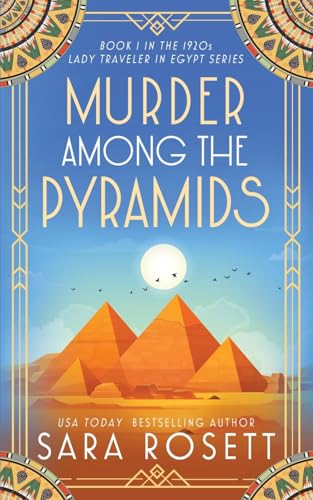
A new historical mystery series from Rosett is always welcome news. I listened to the audiobook on Hoopla Digital, with excellent narrating by Elizabeth Klett. Rosett researched 1930s Egypt, lady explorers, and more to creating the first Lady Traveler in Egypt mystery, featuring Blix Windway and Hildy Honeyworth. Blix was introduced in the 6th High Society Lady Detective series, Murder on a Midnight Clear. The author intends to continue the earlier series.
Blix is a resourceful young woman, traveling the world, taking photos, and delivering lectures to women’s groups. Often, she works as a lady’s companion to fund her travels. Arriving in France after a rough channel crossing, Blix needs to find a new patron to cover her travel past Paris. In Paris, Blix and her new traveling companion, Hildy Honeyworth, participate in an exciting road race in Paris.
They travel on to Marseilles, Alexandria, and then to Cairo, Egypt. There is a death in a tent near the pyramids, and an Egyptian diary and expensive jewelry go missing. When society gossips start whispering that Hildy is a suspect, Blix investigates. With the help of reporter Mr. Denby and the scornful Mr. Heathcliff, who works with but not for the police, Blix finds many clues, and almost gets caught up in a street riot. Egypt of the 1930s is vividly described, and Blix is a very appealing amateur detective. I thoroughly enjoyed this mystery, which is wonderful historical armchair travel. I look forward to Blix and Hildy’s next adventure, on a trip down the Nile.
What Time the Sexton’s Spade doth Rust by Alan Bradley
After a five-year wait, another Flavia de Luce mystery is most welcome. Flavia is a young teen in early 1950s England, a skilled chemist, and an amateur sleuth. Her clever younger cousin Undine has come to live in the large family house in Bishop’s Lacey, and constantly shadows Flavia. Flavia’s sister Daffy is still there, but oldest sister Ophelia is now married. Dogger and Mrs. Mullett look after the three girls and the house since their father’s death. Flavia and Dogger have long chats in the greenhouse.
Mrs. Mullett has also started cooking meals for Major Greyleigh, her long ago sweetheart. When he is found dead, she is suspected of cooking him poisonous mushrooms for breakfast. While sleuthing, Flavia uncovers a huge family secret and learns that Mrs. M also knows. Does Dogger? British intelligence is operating nearby and it looks like Flavia, Dogger, and also cousin Undine will have more fiendishly clever cases to solve in the future, to the delight of Flavia’s many fans.
Maria: A Novel of Maria von Trapp by Michelle Moran
Fran, an aspiring writer, works for Oscar Hammerstein in 1959. He is completing the final songs for a new Broadway show, The Sound of Music, starring Mary Martin. Maria von Trapp, unhappy with the script, comes to New York City to request some changes. Fran is sent to take her to lunch and they end up meeting several times. Maria doesn’t like how her late husband Georg is portrayed as a stern parent and thinks that the whole second half of the show is pure fiction. Also, Liesl is really Rupert. Maria was the stricter parent, after being raised by her grandmother in her aunt and uncle’s home. Maria’s father was a musician, who gave her a guitar.
Fran’s story as a working girl in 1959 New York is also quite interesting, as is her romantic life. Maria shares highlights of her life story with Fran, who gets to know Maria and her youngest daughter, and takes detailed notes for Oscar, who is ill. The last song he writes for the show is “Edelweiss,” not actually an Austrian folk song. The real-life stories of Maria and the von Trapp family make for a compelling read, and should appeal to readers of biographical fiction or fans of The Sound of Music.
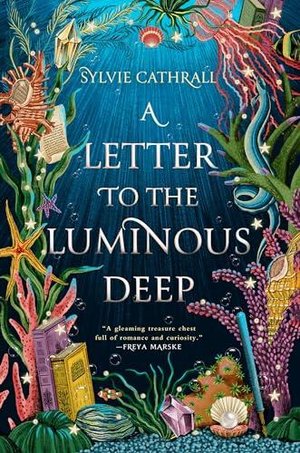
This is a wondrous and strange story told in letters, journal entries, the equivalent of email, poems, and archives. It reads like historical fantasy, but it might not be. Most people live on or under the sea, with an archipelago of islands the only land around. Two of our characters, Sophy and her sister E. grew up in the Deep House, the only residence built deep underwater, designed by their mother, an architect. E. has anxiety and rarely leaves home. She is affronted when her artist brother arrives unannounced with his fiancée to study a structure that has appeared nearby. E. corresponds with Scholar Henery. Later Henery’s brother Vyell also corresponds with Sophy.
This marine world is described beautifully, as are scientific explorations on and far beneath the surfaces. Most of the characters are scholars, and descriptions of their colleagues and academic departments delight. Emails are known as automated posts. The language is a bit flowery, as of another era, though women are equal with men in academia and gay marriage is common. There are hints of a calamity and plenty of excitement, along with mystery, humor and some gentle romance. Book Two of The Sunken Archive is planned.
I thoroughly enjoyed reading this historical rom com, set 20 years after the events of Romeo & Juliet. In this version, Romeo and Juliet have a different ending, and are raising a family in Verona. Oldest child Rosaline is almost 20 and still unmarried. She’s had a few fiancés, but has matched them with other young ladies. Then Duke Stephano, widowed multiple times, encounters Rosie and wants to marry her, even without a dowry. Rosie is enamored of fair Lysander, who climbs into the Montague compound with a special ladder, and they have a few humorous encounters. Then there’s the scarred Prince Escalus, who’s raising his young sister, Princess Isabelle. Rosie’s whole family likes Isabelle, and she enjoys their lively and boisterous household, with loving parents. Many women are attracted to Romeo, but he only has eyes for his Juliet, who is pregnant, again. Romeo still has a temper, as does Rosie.
Rosie spends time at the apothecary shop run by Friar Laurence, escorted by her formidable Nurse. They all go to the scene when a young man is poisoned, and later find another apothecary dead. Rosie is soon suspected of murder and needs to clear her name lest she be sent to a nunnery, so she investigates. The investigation makes this novel a mystery, but it’s mostly a family story set in Verona with some romance and quite a lot of humor. I enjoyed the setting and the characters, and look forward to a planned sequel. The recipe for Juliet’s fruit and nut bread is available on the author’s website, here.
The Hazelbourne Ladies Motorcycle and Flying Club by Helen Simonson
In 1919, Constance Haverhill has lost her mother to influenza and then her nephew. She helped run the local estate during the war, but now is sent to a seaside hotel in Hazelbourne as companion to Mrs. Fog, convalescing from the flu. Constance has no home or permanent job since her mother’s death. This historical novel seems to be meant to occasionally move the reader to anger or indignation on how some of the characters are treated, by other characters or society at large.
Captain Harris Wirrall, a pilot in the war, lost a leg and can’t get work as a pilot. His sweetheart doesn’t want him, and his mother is remodeling Penneston Hall with funds he doesn’t have. His sister Poppy runs a women’s tax business: motorcycles with side cars. Hotel waiter Klaus, with German ancestry, has daily indignities to face, and more. Mr. Pendra gets discriminated against simply for being Indian, though he served valiantly in the war. A German U-boat is stranded on the beach, and the leaders of Hazelbourne try a variety of ways to have it removed or destroyed.
I attended Jane Healey’s Historical Happy Hour recently where she interviewed author Helen Simonson. Helen, who lives in Sussex and is best known for her book Major Pettigrew Takes a Stand, researched this novel from home in 2020. Among other digital resources, Helen read digitized issues of early motorcycling magazines, and learned about another town with a stranded U-boat. Her grandparents had a motorcycle with a sidecar.
Constance’s childhood friend, Mrs. Fog’s granddaughter, is coming back to Hazelbourne for a wedding to a rather unpleasant American. Mrs. Fog reconnects with her old sweetheart from Barbados, but her family doesn’t approve. Constance finds herself taking a few flying lessons, and stands in as a copilot when someone else gets cold feet about flying in a Sopwith Camel.
Other than mysteries, I haven’t read many books set immediately after World War I. The author’s research helped Constance’s daily life and the seaside setting come to life. This is a memorable though bittersweet read, as women find it hard to keep jobs after the war and everyone is grieving the loss of someone from either the war or influenza. Constance, Harris, Poppy, and Mrs. Fog are all vividly drawn characters, and I wanted to read more about them.
This is a heartwarming historical novel, set during World War II, on the Home Front in England. My sister suggested the book to me, and her book club is planning to discuss it later this year. I listened to the audiobook, narrated by Jilly Bond. I took three weeks to savor the audiobook, and found myself thinking about the characters and the story at other times. It is very British, and often funny, even though it’s set during the war.
Gertie Bingham misses her late husband Harry so much that she is thinking of retiring and moving to a beach side town with her dog, Hemingway. She wants to sell Bingham Books, on the outskirts of London, to another bookseller, but her realtor hasn’t found the right buyer. Gertie’s assistant Betty is continuing to run their longtime book club, but Gertie’s stopped participating. Gertie’s Uncle Thomas, who owns a bookstore in London, is dismayed at her plans, as is her longtime friend Charles. Instead, Charles wants Gertie to consider fostering one of the Jewish children he is helping rescue from Germany. Reluctantly, she agrees, but only if the child is a girl who can already read. Enter Hedy Fisher, a serious young teen. First there’s the language barrier, and Hedy’s homesickness for her parents and brother Arno. Hemingway the dog and Betty become Hedy’s friends. Gertie and Elsa, Hedy’s mother, correspond, and gradually Hedy and Gertie learn to understand each other. When war is declared between Germany and Great Britain, all Hedy’s family can send are 25-word telegrams. Then the air raids begin in England.
The community comes together in the war effort, and they discuss books in the bookstore’s air raid shelter. A few women in the neighborhood are prickly types, but have soft hearts underneath. There are some romances and a few wartime marriages, and the book club extends its reach by mail all over Europe. While there are dark days in plenty here, the war violence is off screen. I won’t share more of the plot as it might take away from the experience of reading this deeply satisfying and engaging story. Gertie and Hedy, along with Hemingway, should win the hearts of many readers.