Outlandish

Outlandish: Walking Europe’s Unlikely Landscapes by Nick Hunt

I enjoyed reading this combination of hiking memoir, geography, nature, history, culture and more. In 2019 Nick, a British travel writer, hikes through arctic tundra to visit two tiny glaciers, in Scotland. Wintry weather makes the hikes quite challenging. But maybe he’ll see the Gray Man, or reindeer.

Next, he travels to Poland and Belarus to walk through parts of the Białowieża rainforest, which is threatened by logging and road building like so many forests, as well as disease. Bison and wolves might be glimpsed here. The border area is quite militarized, yet Nick feels the urge to stray from the paths. Sometimes he camps in a tent during his adventures, other times in motels or guest houses.

In Spain, Nick travels thru the Tabernas desert, made of rock, not sand, during the 2nd hottest summer on record. The desert is near the Mar de Plástico, the Plastic Sea, which is made of polytunnels where more than half of the fruit and vegetables sold in Europe are grown. Many of the workers are migrants from Northern and Saharan Africa who endure sauna-like conditions. In the Spanish desert, many western movies were filmed, and there is still entertainment styled after the wild west. Nick finds the light dazzling, and while having stored several days of water at his camp in a slot canyon, has to remind himself to return each day before running too low on water. Ibex are frequently spotted on the heights of the canyon walls.

The final adventure is on Hungary’s grassland Steppe, almost completely flat, except for ancient burial mounds. He sees native horses, wallowing water buffalo, and miles and miles of grassland. A festival of Europeans and Asians of the grasslands celebrates horses, unusual alcoholic drinks, and even remembrances of Attila the Hun and Genghis Khan.

Vivid writing, great armchair travel writing, and thoughtful explorations of places that are remnants of the past, and how changing climates affect them. A memorable read.

Brenda

The Plant Hunter

The Plant Hunter: A Scientist’s Quest for Nature’s Next Medicines by Cassandra Leah Quave

This is a compelling memoir about a remarkable scientist. Cassandra Leah Quave, PhD, is an ethnobotanist who is a tenured professor of Dermatology and Human Health at Emory University in Atlanta, Georgia, and the curator of their herbarium. Every summer she and her family travel the world with her students to search for rare plant specimens that may have antimicrobial or other medicinal uses, and then process the plants for the herbarium. Over her career, she has traveled to the Amazon in Peru, Florida, a Mediterranean island, and to Ginestra in southern Italy, where she met her Spanish Italian husband, Marco.

An early staph infection sparked Quave’s interest in medicine, and a prosthetic leg has made her field research even more challenging. She and her husband are raising three children and a nephew, and cared for her grandmother. Quave makes a passionate plea for funding research of plants with possible medicinal value and for herbariums, and describes the daunting request process for grant money, and for tenure. I enjoy memoirs, especially of women scientists, and this is an outstanding true story. Her podcast is Foodie Pharmacology, and her websites are etnobotanica.us and cassandraquave.com.

Readalikes include Lab Girl by Hope Jahren, The Arbornaut by Margaret Lowman, and From Scratch: A Memoir of Love, Sicily, and Finding Home by Tembi Locke.

Brenda

Shell Drawing

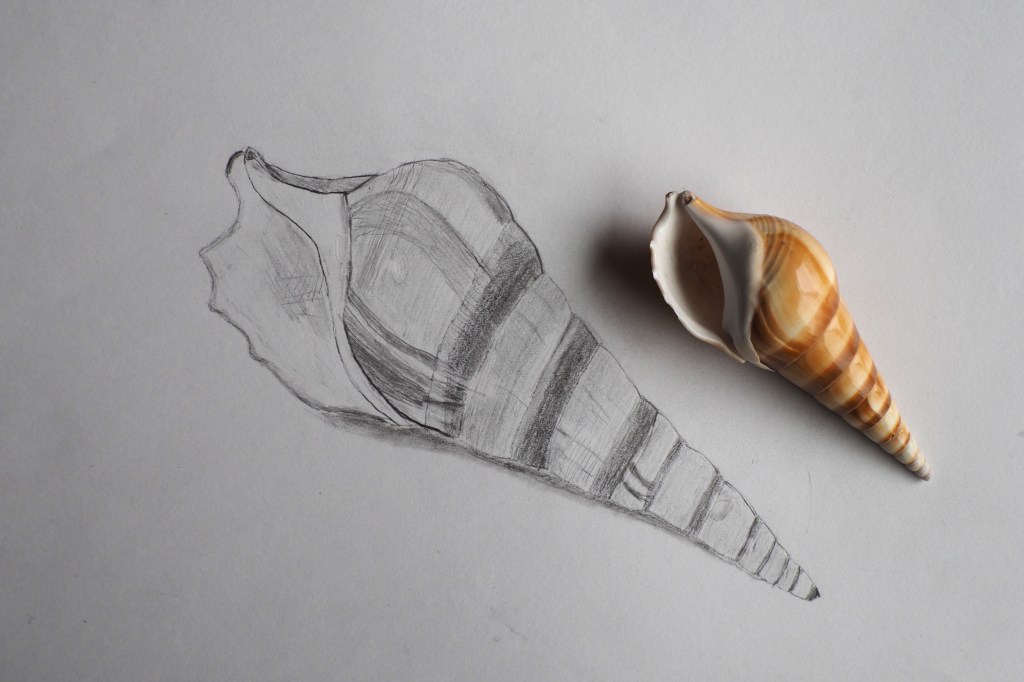
I have some book reviews not quite ready to post, so here’s my larger than life-size drawing of a shell, in graphite pencil. I took a Learning to Draw Nature class recently, and have acquired a collection of graphite and colored pencils. It’s fun to plan what to draw next, while it’s hard to decide when a drawing is finished.

Brenda

Atlas of a Lost World

Atlas of a Lost World: Travels in Ice Age America by Craig Childs

In this engaging combination of armchair travel and popular science, author Childs gives readers a glimpse into the Americas during the last Ice Age, from about 30,000 to 11,000 years ago. In his travels across the Americas, especially Alaska, to explore key archeological sites, he travels alone or with assorted companions, including his mother, archeology students and their professor, and his two children. He kayaks in the north Florida swamps, camps overnight in below zero temps and on the way to Burning Man in the Black Rock Desert, finds mammoth footprints in the American West, and meets with scientists and Native scholars.

A number of questions are considered, not all of them answered. When and how did people arrive in the Americas? Did they walk across the Bering land bridge, and/or journey in skin boats along the coast? Did some people come from Iberia, now Portugal and Spain? What large animals did they encounter, and what did they eat? How did they travel during expanding and receding glaciers, and during sea rise? Tools and weapons were made from materials that were routinely carried for hundreds of miles, which indicated travel and trade. Mammoths and mastodons were common, then rare, and finally extinct as the climate changed. What was the significance of a mammoth hunt during different eras? Childs visits deserts, cliffs, caves, rivers, and coasts, describing how they look now, and what they probably looked like 11,000 to 25,000 years ago to early human travelers. Lots of research, amazing travels, and compelling writing make for a very appealing read. The illustrations by Sarah Gilman enhance the reading experience.

Readalikes include The Sun is a Compass by Caroline Van Hemert, Hudson Bay Bound by Natalie Warren, The High Sierra by Kim Stanley Robinson, and The River: A novel by Peter Heller.

Brenda