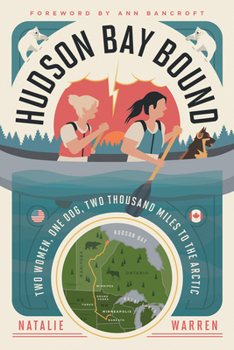
Hudson Bay Bound

Hudson Bay Bound: Two Women, One Dog, Two Thousand Miles to the Arctic by Natalie Warren

In 2011, two Minnesota college seniors made a bold plan for the summer after graduation. Ann Raiho and Natalie Warren decided to canoe 2,000 miles from St. Paul, Minnesota to Hudson Bay in Manitoba, which had never been done by women. Natalie grew up in Miami, but went on long canoe trips in the Boundary Waters area of northern Minnesota as a teen, where she met Minnesotan Ann. They found out they were both planning to attend St. Olaf College in southern Minnesota, as I did, though quite a few years earlier. They were very experienced at long canoe trips, though always with a larger group. Planning and funding such a big expedition was challenging. Natalie had no firm plans or job offers after graduation, while Ann was due in Colorado in early September for graduate school.

At the beginning of June, 2011, they headed out on the flooded Minnesota River, traveling past many fields of corn and soybeans, ready for adventure. Three resupplies were planned, one with the help of Ann’s parents. Traveling through Minnesota, North Dakota, and Manitoba, they met a wide variety of farmers, villagers, and First Nations people. Along the way they saw deer, moose, caribou, eagles, wolves, beaver dams, black bears, many mosquitos and flies, and near journey’s end, polar bears. Also, they adopted a stray dog, Myhan, recommended for polar bear country.

There was lots of cribbage, music from ukelele and a travel guitar, dancing, very few showers, at least one day of not speaking, and many granola bars and pancakes. Ann had the idea for the journey, and Natalie was happy to go along, up rivers, through the vast Lake Winnipeg, and amazing scenery. Natalie sang jazz standards (which ones?) when nervous, which irritated Ann, who thought Natalie wasn’t serious enough about safety. Natalie, in turn, thought Ann made too many decisions without asking for Natalie’s input. Many rapids and portages made for an occasional grueling adventure. They got physically stronger during their 100-day journey, and their friendship survived, and even thrived. For photos and videos, visit Natalie’s website here.

Brenda
Cave of Bones

Cave of Bones by Lee Berger and John Hawks

Real life adventure and popular science combine in this thrilling, controversial book. First, in 2008, paleoanthropologist Lee Berger was out hiking with his dog and his son Matthew, 9. He was looking for potential sites to excavate, when Matthew found a fossil, which turned out to be a new species of hominin, Australopithecus Sediba, dated to about 1.9 million years old.

Then, in 2013, three cavers exploring for Lee Berger found a very deep and all but inaccessible cave, later called the Dinaledi Chamber, where they took photos of what appeared to be hominin bones. Berger quickly organized a three-week excavation, advertising for slender paleoanthropologists who weren’t claustrophobic. I have been on guided walks in several caves, but I’ve never gone spelunking or caving, where you need a headlamp and the ability to crawl, climb and rappel through very tight passages. The Dinaledi Chamber was extremely hard to access, with a tight squeeze through one tunnel, a climb into another, and finally a twelve-meter chute to climb down, through which most climbers would get stuck. Then they went through another chamber and finally into the magnificent Dinaledi Chamber, with beautiful flowstone above, and fossils almost everywhere below. The fossilized bones of at least 15 individuals were found, and over 1000 bones.

As the fossilized bones were revealed, carried out to the surface and analyzed, they found they had discovered a new species, named Homo Naledi, later estimated to be 250,000 to 350,000 years old. The brain was very small, and the shoulders and upper arms were like a climber, but the wrists, fingertips, and feet were much less primitive, not unlike our own. Also, their teeth and the hardened calculus around them indicate that they ate some plants. They were probably about 5 feet tall, with long arms, and walked upright. The exciting part is that Berger and his team, including co-author John Hawks, found some evidence of fire, graves, art and possibly tools.

I watched a Nova documentary from 2015, Dawn of Humanity, about the work done up to that time, and read a couple of recent articles about their findings. While National Geographic is firmly backing Berger and his team’s work, other scientists don’t agree with all these findings, particularly that of fire, art, and tool use. It will be interesting to see what else is found in the Rising Star Cave system. One very exciting section details Berger’s quest to enter the cave himself. In his late fifties, he is tall and not slender, but loses about 50 pounds to make the attempt, during which he spots some markings outside the chamber. Does he get down the chute? I’m not saying, but on his way back out of the cave system, he almost gets stuck and was reportedly injured. Also, he deliberately didn’t tell his family about his attempt to enter the Dinaledi Cavern ahead of time. As teens, Matthew Berger and his sister Megan both successfully made the journey.

The finds in the Dinaledi Cavern, however controversial, are remarkable and make for a compelling and fascinating read. For those with Netflix, there’s a new documentary, Unknown: Cave of Bones. For more about paleoanthropology, I enjoyed First Steps: How Upright Walking Made Us Human by Jeremy DeSilva. For real life adventure and caving, there’s Into the Planet: My Life as a Cave Diver by Jill Heinerth.

Brenda

The Underworld

The Underworld: Journeys to the Depths of the Ocean by Susan Casey

Journalist Susan Casey has long been fascinated by the ocean. She’s written books on sharks, rogue waves, and dolphins. Here she shares the joy and wonder she experiences while learning about and visiting the ocean depths. She travels around the globe interviewing scientists and explorers, including Don Walsh and Victor Vescovo. The book is full of photos of the weird, wonderful, and numerous creatures of the deep ocean.

It’s fun to read about her experiences at sea. Her first chance to dive in a submersible to the deep ocean comes in the Bahamas, where the 3-person Neptune goes to the bottom of the twilight zone, 1000 meters deep.

Another intriguing chapter involves the search for a Spanish galleon off the coast of Columbia, that was sunk in 1708, with a cargo full of treasure. The challenges of locating the ship, keeping that location secret, and obtaining funding and permission to raise the ship are detailed.

More sobering sections discuss the risks of plastic debris on the ocean floor and recent proposals for deep sea mining.

The most exciting chapters describe Case’s final chance to dive to the abyssal zone, over 5000 meters below the surface in a 2-person submersible, to the base of one of Hawaii’s underground volcanoes.

Armchair travel, popular science and real-life adventure combine in a compelling and informative read.

Brenda